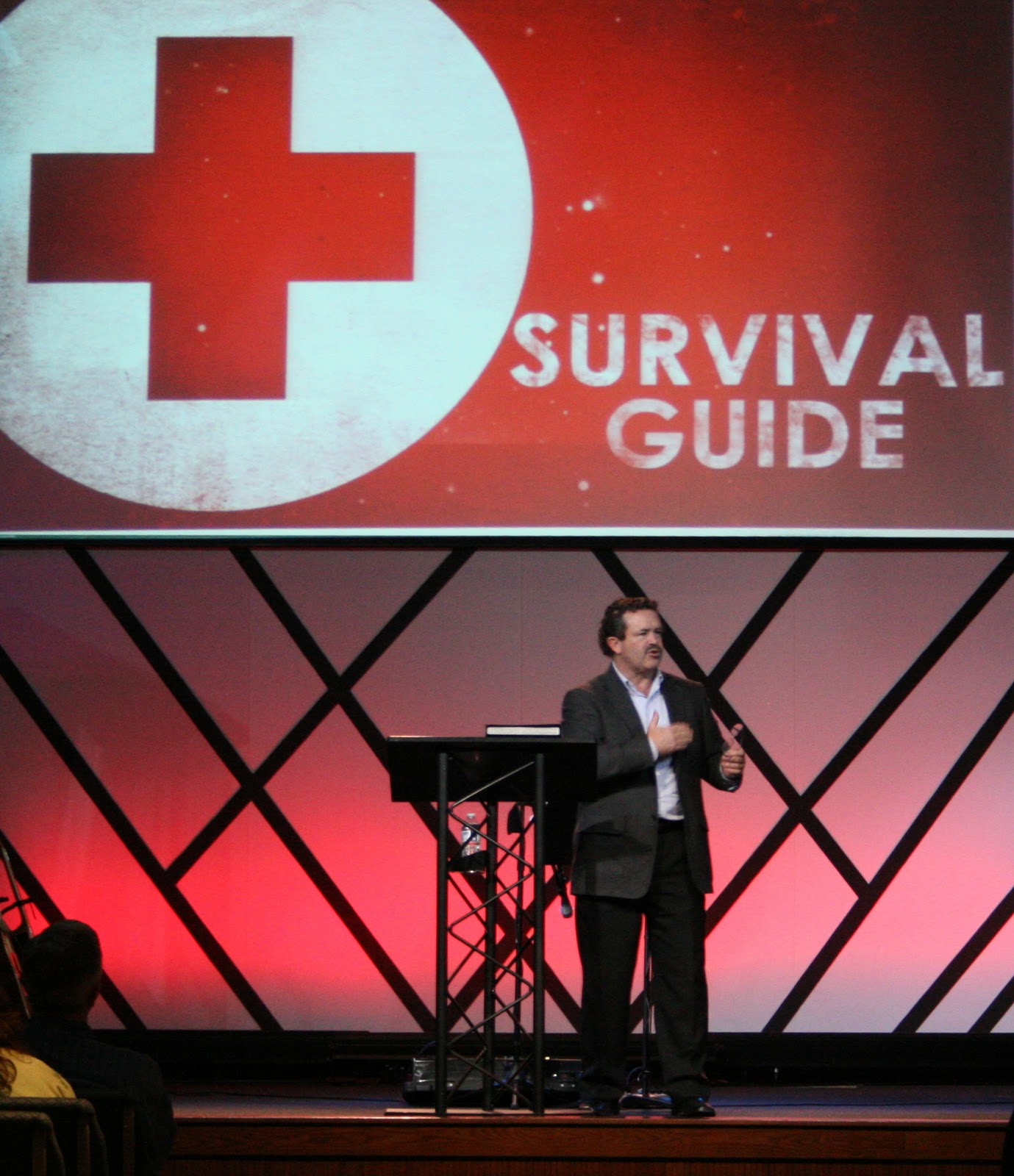
Sunday, November 27, 2011

The Faith of Leap

From a message preached on November 06, 2011, by Pastor Randy Thornton, pictured above


Pastor Randy Thornton said he saw Jordan, a small child, holding his father’s hand. As father and son came to a descending flight of stairs, Jordan boldly negotiated the first step but would have missed the second and stumbled had his father not air-lifted him by the hand and zoomed him to the bottom of the stairs.

That pictured “The Faith of Leap,” said Thornton, senior pastor of Grace Church in Southern Pines, N.C. He delivered the following message, “The Faith of Leap,” on Sunday morning, Nov. 6, 2011. Someone said he should call his message “The Leap of Faith,” but he called it “The Faith of Leap.”

“By faith Abraham, when called to go to a place he would later receive as his inheritance, obeyed and went, even though he did not know where he was going” (Hebrews 11:8 NIV).

“Abraham was called from Ur of the Chaldees,” Thornton said. The ancient city of Ur was located in southern Mesopotamia, near the Euphrates River. “He was called from a plush land to go to a barren land. Being able to hear from God is very crucial for our livelihoods and families. Abraham was 75 when he left Ur of the Chaldees. ‘As a man thinks in his heart, so is he.’ If you don’t think you’re smart enough, you probably never will be. Everyone say, ‘I’m God’s favorite child.’ God has greater plans than what we can see.”

Thornton said there are going to be some young “Davids” among the youths of our time and that Paul told Timothy, a young Christian, to set an example for the believers.

“When did David begin to be a giant-killer?” Thornton asked. “David killed a wolf, a bear, a lion. David heard Goliath and believed God. He believed God gave him the victory – not he, himself. God wants to teach us to be giant-killers – young and old.”

Taking a leap of faith depends on the “faith factor.”

“James says show me your faith by your works,” Thornton noted, adding that the necessary step of risk is the faith of leap. “Satan wants to cripple us. Conviction is a gift from God. Condemnation is a gift from Satan. Satan does not want us to take that leap of faith. He wants to cripple us, immobilize us and tell us we’re junk.”

“If we claim to be without sin, we deceive ourselves and the truth is not in us. If we confess our sins, he is faithful and just and will forgive us our sins and purify us from all unrighteousness” (1 John 1:8-9). 
  
To exercise faith, one must take a risk, expecting God to do a miracle.

“God wants you to know he loves you and is going to take care of you when you step out in faith. He wants to bless you, so you can bless others,” Thornton said. “Many say they have faith in God – ‘We have entrusted our lives and hopes to a good and powerful God’ – but this faith is usually inward and passive, inwardly focused, comforting, with a sense of security.”

That’s good, Thornton said.

“The other kind of faith is active and is outwardly focused and usually very discomforting,” he said. “Knowing that we are sent and to whom we are sent, we take deliberate risks that put us in complete dependence on God for a miracle.”

Many Christians play the “safe mode.”

“It’s time to kick it up a step,” Thornton said. “The risk key is a purposeful action you take, in spite of discomfort or fear, to exercise your faith during an act of obedience.”

Matthew 17:19-20: Then the disciples came to Jesus in private and asked, “Why couldn’t we drive it [a demon] out?” He replied, “Because you have so little faith. Truly I tell you, if you have faith as small as a mustard seed, you can say to this mountain, ‘Move from here to there,’ and it will move. Nothing will be impossible for you.”

“How many of you parents know your kids have to learn some things the hard way?” Thornton asked. “How many of you know you are all in fulltime Christian ministry? The amount of our faith is directly related to our understanding that we have heard from God.”

“And he did not do many miracles there because of their lack of faith,” (Matthew 13:58).

“Sometimes those who are going to be the last to believe you’ve heard from God is your own family,” Thornton said. “We must name our unbelief in an all-powerful God – where it lies – and reject it [unbelief]. If we want to pursue the life of the supernatural, we must take action. I’m really glad it doesn’t take a superstar. It just takes you and me.”
Thornton prayed this benediction:
"Father, I thank you, today, that we are your favorite children because of what you’ve done on the cross … God, I pray you’d begin to set your people free in Jesus’ name … Raise up a generation of young people wholly devoted and sold out to you!”

Wednesday, November 23, 2011

A Child Is Impressionable

A lady (on the left in this photo) worships with her arms half raised, while her granddaughter, standing in the center aisle, lifts her hands during a 2011 worship service at Grace Church in Southern Pines, N.C. Most children attending this service had already gone to Grace's children's church meeting, but the grandmother in this photo wanted her granddaughter to experience the worship service before joining the other children. (Left-click on this photo and see it enlarged.)

Wednesday, November 9, 2011

Dealing with Despair

From a message given by the Rev. Randy Thornton (pictured above) on September 5, 2010

“Despair can come in a multitude of situations,” said Senior Pastor Randy Thornton, 52, during a recent sermon at Grace Church in Southern Pines, N.C., “but for believers in Jesus Christ, God has given us hope.”

The word “despair” means “sunk down,” and the word “encourage” in Greek means “putting wind in your sails to move you forward,” Thornton said, adding that despair involves a sense of hopelessness and can connect to past wounds.

“Despair slices your sails and leaves you dead in the water,” he said.

King David wrote, “O my God, my soul (one’s “soul” involves one’s mind, will and emotions) is cast down within me: therefore will I remember thee from the land of Jordan…” (Psalm 42:6).

Thornton referred to the Old Testament account of Nehemiah the Cupbearer:

According to writer John C. Westervelt, the Hebrews of Judah, the Southern Kingdom of divided Israel, were exiled to Babylon before Nehemiah’s time. The Persians under King Cyrus overthrew the Babylonians in 539 B.C. The new king let foreigners return home. Cyrus decreed that Hebrews could return to Judah and rebuild the temple in Jerusalem. Fifty thousand Jews accepted the offer to go home. Nehemiah had risen through the ranks to become cupbearer to King Artaxerxes. Besides certifying wine served to the king was safe, Nehemiah was a counselor to the king. When Nehemiah asked men who returned from Judah about the Jewish homeland, they said, “The wall of Jerusalem is broken down, and its gates have been burned with fire.”

Nehemiah fasted and prayed. He had never shown sorrow in the king’s presence, but the king saw his sad countenance and inquired. Nehemiah said, “May the king live forever! Why should my face not look sad when the city where my fathers are buried lies in ruins, and its gates have been destroyed by fire?" (Nehemiah 2:3).

The king sponsored Nehemiah’s return and his project to rebuild Jerusalem. The prophesied 70 years of Jewish captivity were fulfilled when the new Temple was completed in 516 B.C., but Nehemiah faced danger and despair while rebuilding the Temple.

“Meanwhile, the people in Judah said, ‘The strength of the laborers is giving out, and there is so much rubble that we cannot rebuild the wall’” (Nehemiah 4:10).  

Fatigue may cause despair by draining energy and making a person feel as though he “can’t take another step,” Thornton said.

Despair often comes when we are in the middle of building. Jerusalem’s walls were erected halfway when discouragement came (Nehemiah 4:6).

“You may say, ‘I thought I was a good Christian until I got married,’” Thornton noted. “In life, God doesn’t put two perfect people together. We walk into relationships wounded and hurt. And what do wounded people do? They wound people.”

There is a good plan God has for you, but we often have to go through “dark timber,” he said.

Thornton, who grew up in Colorado, described his love of hunting and hiking in that state’s rugged mountains. He told of encountering forests with foliage that darkened the sun and of growing weary of “one more log to cross.”

“‘Dark timber’ is so thick you lose direction, lose perspective,” he said. “In life, we’re all going to have patches of ‘dark timber.’”

Failure can generate despair that dominates our feelings, but we must trust God. “And we know that in all things God works for the good of those who love him, who have been called according to his purpose” (Romans 8:28).

“Emotions don’t tell you the truth all the time,” Thornton said. “There is a ‘clearing’ on the other side.”
Fear may cause despair.

“There is a spirit of Sanballet and Tobiah that wants to kill you,” Thornton said, referring to Nehemiah 4, which tells of conspirators against the Jew rebuilding Jerusalem. “But we are more than conquerors. We cannot let fear dominate us. Despair is not the expression of faith.”

How to get rid of despair:

1. Get rest for your body.

“In vain you rise early and stay up late, toiling for food to eat – for he grants sleep to those he loves” (Psalm 127:2).

Do something that energizes you, Thornton said, adding that God created a time for rest.

“There are six days when you may work, but the seventh day is a Sabbath of rest, a day of sacred assembly. You are not to do any work; wherever you live, it is a Sabbath to the LORD” (Leviticus 23:3).

“Our culture has robbed us,” Thornton said. “God created a Sabbath rest. God designed a day to bet built up with the love of God.”

“But seek first his kingdom and his righteousness, and all these things will be given to you as well” (Matthew 6:33).

“Put God in your life,” Thornton said.

2. Reorganize your life.

Get priorities straight.

“The fire must be kept burning on the altar continuously; it must not go out” (Leviticus 6:13).

“God put us in families,” Thornton said.

“Two are better than one, because they have a good return for their work” (Ecclesiastes 4:9).

“Lone rangers always get shot down,” Thornton said.

“Though one may be overpowered, two can defend themselves. A cord of three strands is not quickly broken” (Ecclesiastes 4:12).

“Reorganize your life,” Thornton said. “You may be here today, and you’re trying to do life alone.”

“For he chose us in him before the creation of the world to be holy and blameless in his sight. In love he predestined us to be adopted as his sons through Jesus Christ, in accordance with his pleasure and will” (Ephesians 1:4-5).

3. Remember the Lord.

“When you pass through the waters, I will be with you; and when you pass through the rivers, they will not sweep over you. When you walk through the fire, you will not be burned; the flames will not set you ablaze” (Isaiah 43:2).

Three things to remember when feeling despair:
God knows your situation.
God cares about your situation.
God can change you and your situation.

The Apostle Paul wrote, “I pray also that the eyes of your heart may be enlightened in order that you may know the hope to which he has called you, the riches of his glorious inheritance in the saints, and his incomparably great power for us who believe. That power is like the working of his mighty strength, which he exerted in Christ when he raised him from the dead and seated him at his right hand in the heavenly realms, far above all rule and authority, power and dominion, and every title that can be given, not only in the present age but also in the one to come” (Ephesians 1:18-21).

“Despair is a real thing,” Thornton said. “You don’t have to stay there. You have a choice! Believe there’s a clearing at the end, or stay in the dark timber!”                        

Sunday, October 16, 2011

God's Guarantee


From a September 18, 2011, message by Pastor Randy Thornton, pictured above

As part of a “survivor’s guide” series, Randy Thornton, senior pastor of Grace Church in Southern Pines, N.C., delivered the following message, “God’s Guarantee,” to his congregation.

“America’s rate of poverty increased to a greater rate than ever before,” Thornton said, noting that 46 million U.S. citizens lived below what is considered the poverty level in 2010. “The job loss rate may put more people below the poverty level. Did God fail? Did he lie? Did he exaggerate?”

Thornton’s questions referred to this verse: “And my God will meet all your needs according to the riches of his glory in Christ Jesus” (Philippians 4:19).

With every promise, there is a condition with it,” Thornton said.

The most asked-about subject in the Bible is salvation, but the next most asked-about subject is finances, he said. He recommended courses offered by Crown Financial Ministries and Financial Peace University classes led by Dave Ramsey.

“God says, ‘I will show myself strong to those who are in Christ Jesus,’” Thornton said. “Over the last 50 years, the government has violated biblical principles. We’ve said, ‘God, don’t be a part of our nation.’ What a nation sows, it’s going to reap. Today’s message is about ‘how to put God first in your life.’ God has promised to take care of us, financially.”

Thornton listed five conditions for receiving God’s help: 1. Ask God for his help. 2. Learn to be content. 3. Practice giving by faith. 4. Maintain your integrity. 5. Trust God with your life.

1. Ask God for help: “You desire but do not have, so you kill. You covet but you cannot get what you want, so you quarrel and fight. You do not have because you do not ask God” (James 4:2 NIV).

“We need the favor of God,” Thornton said.

“Ask and it will be given to you; seek and you will find; knock and the door will be opened to you” (Matthew 7:7). Here’s an acronym for “ASK”: A – Ask; S – Seek; and K – Knock.

“God wants to do miracles, so you can share and be a witness for the Lord,” Thornton said.

2. Learn to be content:

“God is far more interested in your character than your comfort,” Thornton said. “In America, we have what I call ‘junkies’ – they go out and buy a new car or a new dress. God is interested in meeting your needs, not your wants. Typically, we Americans tend to spend just a little more than we make.”

“But godliness with contentment is great gain. For we brought nothing into the world, and we can take nothing out of it” (1 Timothy 6:6-7).

“You get to take that which is done for God, with the right heart and motive, to heaven,” Thornton said.

The Apostle Paul said, “I know what it is to be in need, and I know what it is to have plenty. I have learned the secret of being content in any and every situation, whether well fed or hungry, whether living in plenty or in want” (Philippians 4:12).

Thornton said people who used a credit card, during an experiment, spent 23 percent more than those who used cash.

3. Practice giving by faith:

“Remember this: Whoever sows sparingly will also reap sparingly, and whoever sows generously will also reap generously. Each of you should give what you have decided in your heart to give, not reluctantly or under compulsion, for God loves a cheerful giver. And God is able to bless you abundantly, so that in all things at all times, having all that you need, you will abound in every good work” (2 Corinthians 9:6-8).

“A church service where one-third of the message is about the gospel and two-thirds of the service is about raising money – that’s manipulation,” Thornton said, noting that Malachi 3:10 tells us to “test God.”
 
“Sow into the places where you are fed,” Thornton said. “If you give outside your church, don’t do it with your tithes. Do it with your offerings. Honor God with all your increase. Invoke God’s blessing on your life. Your job isn’t safe, but God is the same, yesterday, today and forever.”

He said Grace Church has been blessed and has tons of stories about those blessings.

“I promise you,” Thornton said, “God is true to his Word.”

“Honor the LORD with your wealth, with the firstfruits of all your crops” (Proverbs 3:9).

4. Maintain your integrity.

God wants you to be able to say, “I didn’t lie; I didn’t cheat; I didn’t steal.”

“Guys, you have to live with yourselves,” Thornton said. “Don’t compromise.”

“Better the poor whose walk is blameless, than a fool whose lips are perverse” (Proverbs 19:1). 
 
“But the way of the wicked is like deep darkness; they do not know what makes them stumble” (Proverbs 4:19).

“When you are walking with integrity, God blesses the things you have,” Thornton said. “God blesses you to bless others.”

5. Trust the Lord with your life.

“But seek first his kingdom and his righteousness, and all these things will be given to you as well” (Matthew 6:33).

“Put God first in your life,” Thornton said. “Cultivate a relationship with him. My God shall supply all your needs, according to his riches in glory. Guys, let’s walk in God’s favor. All through the Bible, there are all kinds of stories of supernatural provision… If you’re here and would like to receive Christ as your Savior, would you raise your hand, right now?”

Thornton prayed, “Father, I pray for that hand that is raised…. God, as he surrenders his life, as he prays to receive Christ….”

Thornton spoke to the audience:

“I believe this is the time to do business with God…. Let’s stand and worship…. God is wanting to do more miracles in your life…. I sense there is someone here…God is wanting you to take off the lock to the door of your house and let God come into your family…. I pray for this family where the door has been sort of ‘God, stay out of our lives’…. God, take out the hurt and bitterness and pain…. God, put in an aroma of the presence of God… May Jesus Christ become the center ‘mantel piece’ of that home.”

Sunday, September 18, 2011

How to Be a Casual Christian

From a message by Pastor Randy Thornton

Do you want to be a casual, chilling, complacent Christian?

“Casual” means “showing little interest or concern; nonchalant: lenient and permissive.”

“Chilling” is a slang word meaning “calm, relaxed, idle and easy going.” Young people often describe relaxing as “chilling out.”

“Complacent” means “self-satisfied and unconcerned.”

In a recent sermon, Pastor Randy Thornton of Grace Church in Southern Pines, N.C., used comedian Jeff Foxworthy’s format of “You might be a redneck, if…” and changed that phrase to
“You might be a casual Christian, if….” Here are some of Thornton’s thought-provokers:

You might be a casual Christian, if you value comfort and personal pleasure over the pursuit of the Kingdom of God.

“The one who received the seed that fell among the thorns is the man who hears the word, but the worries of this life and the deceitfulness of wealth choke it, making it unfruitful” (Matthew 13:22 NIV).

You might be a casual Christian, if your desire for independence is more important than God’s will.

“A man's own folly ruins his life, yet his heart rages against the LORD” (Proverbs 19:3).

You might be a casual Christian, if your friends have more influence on you than God does.

“Do not be misled: ‘Bad company corrupts good character’” (1 Corinthians 15:33).

“Do not be yoked together with unbelievers. For what do righteousness and wickedness have in common? Or what fellowship can light have with darkness?” (2 Corinthians 6:14).

You might be a casual Christian, if your eyes are dry and you have no passion for the lost.

“Do you not say, ‘Four months more and then the harvest’? I tell you, open your eyes and look at the fields! They are ripe for harvest” (John 4:35).

“God has called us to be fishers of souls, not keepers of the aquarium,” Thornton said.

Jesus said, “You did not choose me, but I chose you and appointed you to go and bear fruit – fruit that will last…” (John 15:16).

Paul said, “Yet when I preach the gospel, I cannot boast, for I am compelled to preach. Woe to me if I do not preach the gospel!” (1 Corinthians 9:16).

You might be a casual Christian, if you listen to the Gospel without being moved to respond, again.

You might be a casual Christian, if your plans for your future end in retirement and stop short of “well done, thou good and faithful servant.”

You might be a casual Christian, if you have no pleasure in giving to God and hold your tithe for yourself.

“You may say to yourself, ‘My power and the strength of my hands have produced this wealth for me.’ But remember the LORD your God, for it is he who gives you the ability to produce wealth, and so confirms his covenant, which he swore to your forefathers…” (Deuteronomy 8:17-18).

You might be a casual Christian, if…

…your care for what other people think deters you from obedience to the Lord.

…your passion for Jesus was hotter when you were first saved than it is now.

...having fun is more important than serving God.

…what you have and the pursuit of having it is more important than the pursuit of God.

…you avoid the uncomfortable and opt instead to live inside the sacred comfort of your routine.

…you avoid burdens instead of seeking them and carrying them.

…broken relationship stop you from forgiving others.

…if worship is elevated based on the quality of the music rather than on a personal connection with the presence of God.

And you might be a casual Christian, if serving God is regarded as work for those whose rank is a lower on the totem pole than yours, or you say that such work is not your “gifting.”

To find motivation to “totally commit to God,” we should compare the costs of serving God to the benefits; then we should trust God to help us keep our commitments, Thornton said.

“…I know whom I have believed, and am convinced that he is able to guard what I have entrusted to him for that day” (2 Timothy 1:12).

Vision: Dreaming a Dream

Fom a message of hope by Pastor Randy Thornton

“God created man with the power to be creative,” said Randy Thornton, senior pastor of Grace Church in Southern Pines, N.C., as he spoke at the church on a recent Sunday morning. 

Thornton, 52, said animals are born, they live and they die, but God put eternity in the heart of man; a person’s relationship with God and other people reflects the idea that God created us in his likeness.  

“God’s image is in us,” Thornton said. “You have divine design and destiny. God’s plan for you is irrevocable.”

He read this verse: “Now to him who is able to do immeasurably more than all we ask or imagine, according to his power that is at work within us” (Ephesians 3:20, NIV). 

“Have you lost your vision of God’s dream for you? Has your vision bogged down?” Thornton asked. “The history of this church is a testimony to the power of a God-given dream.”

Thornton told of launching Grace Church over 20 years ago. When he brought his family from Manna Church in Fayetteville, N.C., to Southern Pines, he had few regular church attendees. He had spent two years at Grace when snow fell one Sunday morning. After the lady who led music hurried home after the worship part of that Sunday a.m. service, the only man attending said, “I’ll stay so you’ll have someone to preach to.” Thornton said he thought about giving up but knew he should stay. The church “yo-yoed” with 75-20-75-50 etc. people for 10 years. Thornton worked at UPS and pastored his fluctuating flock for 13 years before quitting UPS. Grace Church now has four fulltime assistant pastors and holds two Sunday morning services. Total Sunday morning attendance averages over 1,000. 

Thornton said some people have “no dream.” The results of having no dream are frustrations, boredom and regrets. “Where there is no revelation, the people cast off restraint; but blessed is he who keeps the law” (Proverbs 29:18).

Some have a “low dream,” he added.

We often have small dreams because dreams make us accountable. We may also fear failure or criticism – people may laugh at us.

“If you don’t try things in life, you’re never going to experience life,” Thornton said.

Some people have the “wrong dream,” he noted, and some have a “vague dream.” “A discerning man keeps wisdom in view, but a fool's eyes wander to the ends of the earth” (Proverbs 17:24).

“God has a dream for your life,” Thornton said. He gave these eight steps for realizing “God’s dream for you”:

1. Open your mind to God’s dream. Seek first the kingdom of God. Say, “Not my life, but Your Life.” “He who trusts in himself is a fool, but he who walks in wisdom is kept safe” (Proverbs 28:26).

2. Do some research. “He who answers before listening – that is his folly and his shame” (Proverbs 18:13).

3. Ask for advice (consultation).  “The heart of the discerning acquires knowledge; the ears of the wise seek it out” (Proverbs 18:15).

4. Establish some priorities. “God didn’t create you just to have fun,” Thornton said. “If you live just for yourself, you’ll come up empty, somewhere.”

5. Evaluate the cost (calculate risk). What’s the price tag? Everything valuable in life has a price tag. Proverbs 20:25 warns that an impulsive vow traps you; you'll later want to get out of it.

6. Plan for problems. “Make plans by seeking advice…” (Proverbs 20:18). “A prudent man sees danger and takes refuge, but the simple keep going and suffer for it” (Proverbs 22:3).

7. Be willing to risk it all. “Fear of man will prove to be a snare, but whoever trusts in the LORD is kept safe” (Proverbs 29:25). This involves the “principle of confrontation.”

8. Do it now. This involves the “principle of initiation.” “Commit to the LORD whatever you do, and your plans will succeed” (Proverbs 16:3).

“Some of you have neglected your relationship with God,” Thornton said. “Some of you need to make a decision that things are going to change…I believe God is saying, ‘Don’t waste your life. Live it for me!”

Jesus said, “The thief comes only to steal and kill and destroy; I have come that they may have life, and have it to the full” (John 10:10).

Elements of a Healthy Family

From a message by Pastor Randy Thornton

“God has called us to be in families,” said Pastor Randy Thornton, 53, during a recent sermon at Grace Church in Southern Pines, N.C.  “Family is all about relationships.”

Thornton, 53, Grace’s senior pastor, listed the following six points as he spoke on “How to Have a Healthy Family”:

1. Families make (create) fun.

“Jesus knew how to connect with people – emotional intelligence,” Thornton said.

Jesus said, “The thief cometh not, but for to steal, and to kill, and to destroy: I am come that they might have life, and that they might have it more abundantly” (John 10:10).

“Find creative ways to have fun by doing fun things together,” Thornton said, adding that by having family activities, you teach children how to get along with people.”

Slow down. Schedule some playtime. Ask yourself, “Is there a fun way to do this (chore)?” Do unexpected, new stuff. Plan surprises. Make it happen. Fun often doesn’t just happen.

2. Give attention.

St. Paul said, “…Fulfill my joy by being like-minded, having the same love, being of one accord, of one mind. Let nothing be done through selfish ambition or conceit, but in lowliness of mind let each esteem others better than himself. Let each of you look out not only for his own interests, but also for the interests of others” (Philippians 2:1-4).

“Giving your life away is one of the greatest things we believers should do,” Thornton said.

Find time to unwind. Unplug from things of the day. Learn to listen; let people give opinions without cutting them off to give your opinion.

3. Capture memories.

“…Take heed to yourself…lest you forget the things your eyes have seen, and lest they depart from your heart all the days of your life. And teach them to your children and your grandchildren…” (Deuteronomy 4:9).

“Healthy families capture memories,” Thornton said. “Write it down; get a picture.”

Create several anniversaries. Hang up wedding photos. Family vacations often provide the greatest memories. Return to memorable locations. Photograph and video your children; write letters to loved ones as they grow up.

4. Verbally inspire.

“Therefore comfort each other and edify one another…” (1Thessalonians 5:11). “A good man out of the good treasure…brings forth good things, and an evil man out of the evil treasure brings forth evil things” (Matthew 12:35).

Catch people doing the right thing, and let them know. Weigh your words (the tongue can be a fire, says James). Use words to edify. Write it out; send letters – they are little treasures. Encourage children in front of others (praise them in public; discipline them in private).

5. Love without condition.

“Jesus, knowing that the Father had given all things into His hands…rose from supper and laid aside His garments, took a towel and girded Himself…and began to wash the disciples’ feet, and to wipe them with the towel…” (John 13:3-5).

After Jesus washed feet and ate “The Last Supper” with his disciples, he said, “Little children…A new commandment I give to you, that you love one another; as I have loved you, that you also love one another. By this all will know that you are my disciples, if you have love for one another” (John 13:33-35).

Thornton said he was a teenager and a fairly new Christian when he told his stepfather that he loved him. His stepfather, for the first time Thornton remembers, responded with “I love you.”

“Tell them you love them,” Thornton said. “Love them with actions. Love them with respect – 70 percent of communication is non-verbal.”

6. Yield to God.

“You shall love the LORD your God with all your heart, with all your soul, and with all your strength. And these words which I command you today shall be in your heart. You shall teach them diligently to your children, and shall talk of them when you sit in your house, when you walk by the way, when you lie down, and when you rise up” (Deuteronomy 6:5-7).

“…Choose for yourselves this day whom you will serve...But as for me and my house, we will serve the LORD” (Joshua 24:15).